Julien Danjou

Jun 12, 2025

3 min

read

GitHub's Merge Queue Isn't Enough for Large Teams

landmark photography of trees near rocky mountain under blue skies daytime

Why large engineering orgs quickly hit the limits of GitHub's queue — and what they actually need.

Over the last couple of years, GitHub has been rolling out its own merge queue feature. It's a welcome recognition of a real problem: teams need better ways to manage the complexity of merging changes into main without breaking builds, introducing regressions, or wasting CI cycles.
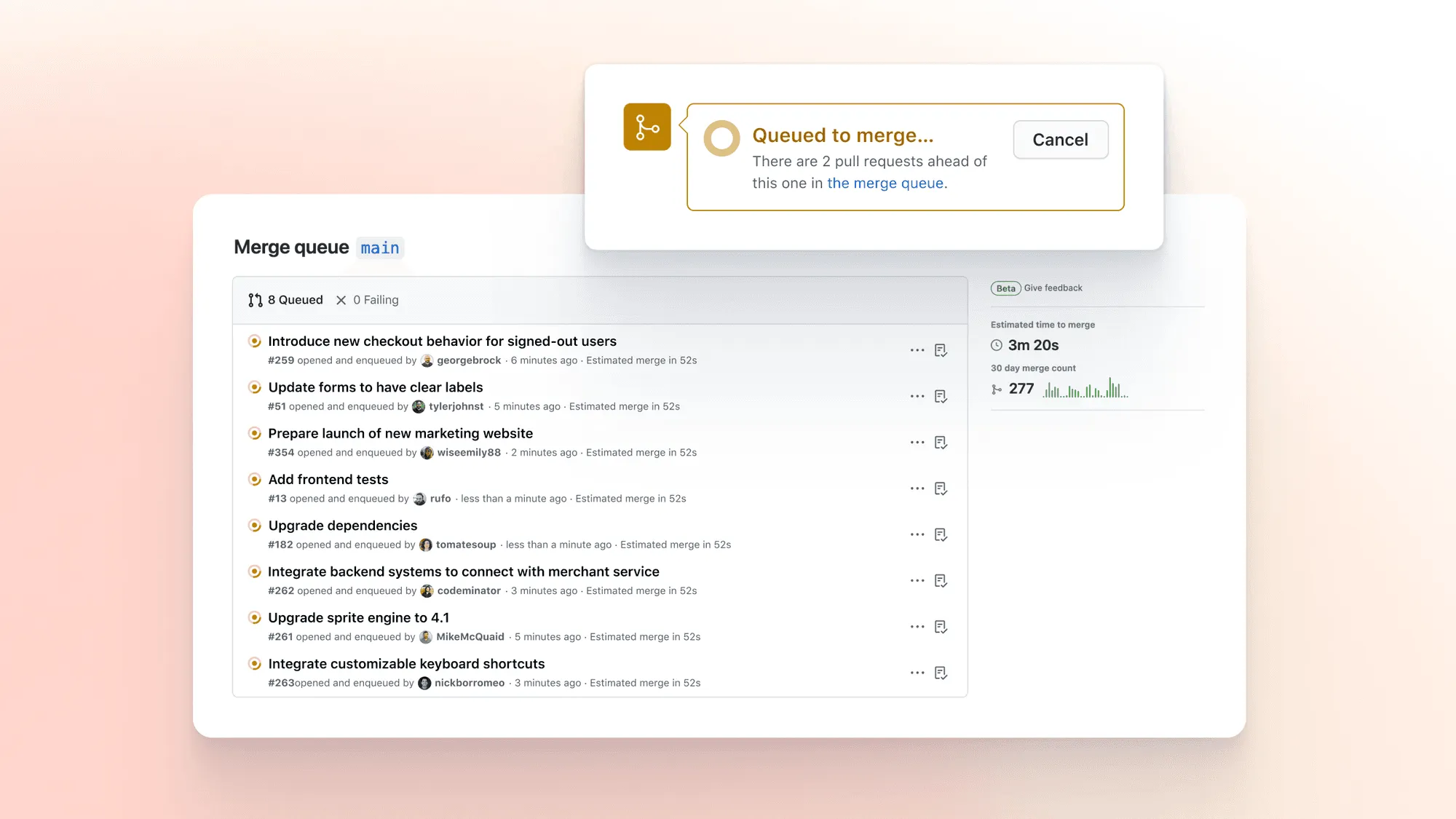
GitHub merge queue

However, for many engineering organizations, GitHub's queue just isn't enough.

Over the last few months, we have spoken with a few large companies that have given it a real try. The result? It failed to meet their needs. Their workflows were too complex, their scale too real, and the limitations of GitHub's merge queue showed up fast.

Here's why.

1. No support for batching

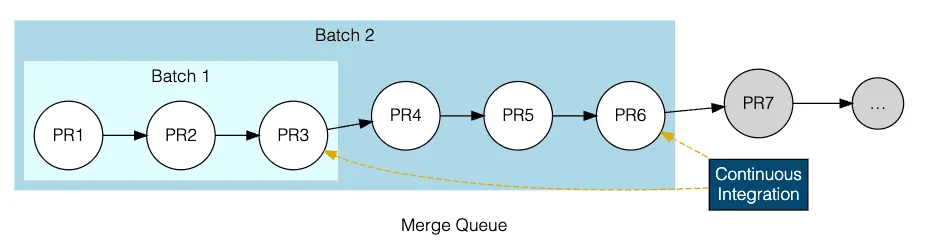
GitHub merges PRs one by one. That might work for small teams or low-frequency repositories. But as soon as your team is pushing tens or hundreds of PRs per day, this becomes a bottleneck.

Mergify supports batching: it groups PRs together, tests them as a unit, and merges them atomically if the build passes. This saves CI time, catches integration issues earlier, and reduces queue churn.

Without batching, you’re stuck in line.
2. No bisect-on-failure strategy

What happens when a batch fails?

At Mergify, we built an intelligent bisect-on-failure strategy. If a batch of PRs fails CI, Mergify will split the batch automatically and re-test, isolating the problematic PR. That means faster merges for the rest of the batch and fewer manual retries.

For high-volume teams, this is a must-have.

3. No priorities, no flexibility

All PRs are treated equally in GitHub's queue. But real teams don't work like that.

With Mergify, you can assign merge priorities. Hotfixes can jump the line. Low-priority or experimental changes can be delayed. And you can customize conditions and workflows across repos and teams.

Merge logic isn't one-size-fits-all. Mergify reflects that.

4. No CI intelligence

GitHub's queue is blind to what happens inside CI. If your tests are flaky, slow, or constantly retrying, the queue won't notice. You'll just feel the pain in delays and confusion.

Mergify is building CI Insights. It's a full observability layer for your merge pipeline:

  • Detect flaky jobs

  • Track retry loops

  • Analyze job duration trends

  • Alert on anomalies

It's not just about merging safely. It's about understanding why you're not.

5. No incident handling or deployment freeze capabilities

Production is on fire. CI is unstable. What do you do?

With Mergify, teams can pause the merge queue and freeze deployments instantly. You can:

  • Define scheduled or manual freeze windows

  • Automatically block merges when incidents occur

  • Resume operations safely once things are back under control

GitHub's queue does not have a built-in mechanism for handling incidents or CI instability, which is a non-starter for any team doing continuous delivery.

6. Most teams don't even need a queue. They need rebase-before-merge.

Ironically, many teams trying GitHub's merge queue don't even need one.

What they need is a way to ensure that code is tested on top of main before it merges. That's exactly what rebase-before-merge does — and Mergify workflow automation supports it out of the box, with less overhead than a queue.

So while GitHub is now following the merge queue path we pioneered five years ago, we're already building what real teams need next.

If your merge queue doesn’t adapt to your team, it’s not helping you ship

Mergify has been battle-tested by thousands of teams over the past 5 years, from early startups to large orgs with massive CI pipelines.

We know what breaks, what flakes, and what slows everything down.

That’s why we built:

  • merge queue that supports batching, priorities, bisecting, and freeze handling

  • rebase-before-merge strategy for teams that need simplicity

  • CI observability layer that sees what your green checks are hiding

Want to see how it all works? Book a demo or try it free today.

Stay ahead in CI/CD

Blog posts, release news, and automation tips straight in your inbox

Stay ahead in CI/CD

Blog posts, release news, and automation tips straight in your inbox

Recommended blogposts

Dec 2, 2025

9 min

read

Lessons From a Noisy Monitor

Your database monitors keep firing even though nothing is wrong? We hit the same problem: noisy IOPS alerts caused by predictable jobs. This post explains how we replaced brittle thresholds with an SLO-based approach that restored signal, eliminated noise, and stopped the monitor from "crying wolf."

Julian Maurin

Dec 2, 2025

9 min

read

Lessons From a Noisy Monitor

Your database monitors keep firing even though nothing is wrong? We hit the same problem: noisy IOPS alerts caused by predictable jobs. This post explains how we replaced brittle thresholds with an SLO-based approach that restored signal, eliminated noise, and stopped the monitor from "crying wolf."

Julian Maurin

Dec 2, 2025

9 min

read

Lessons From a Noisy Monitor

Your database monitors keep firing even though nothing is wrong? We hit the same problem: noisy IOPS alerts caused by predictable jobs. This post explains how we replaced brittle thresholds with an SLO-based approach that restored signal, eliminated noise, and stopped the monitor from "crying wolf."

Julian Maurin

Dec 2, 2025

9 min

read

Lessons From a Noisy Monitor

Your database monitors keep firing even though nothing is wrong? We hit the same problem: noisy IOPS alerts caused by predictable jobs. This post explains how we replaced brittle thresholds with an SLO-based approach that restored signal, eliminated noise, and stopped the monitor from "crying wolf."

Julian Maurin

Nov 27, 2025

5 min

read

Monorepo CI for GitHub Actions: Run Exactly the Tests You Need, Nothing More

Run only the tests that matter in your monorepo. Mergify Monorepo CI detects which parts of your repo each pull request touches and triggers the right GitHub Actions jobs, then aggregates them into a single CI gate for branch protection or Merge Queue.

Julien Danjou

Nov 27, 2025

5 min

read

Monorepo CI for GitHub Actions: Run Exactly the Tests You Need, Nothing More

Run only the tests that matter in your monorepo. Mergify Monorepo CI detects which parts of your repo each pull request touches and triggers the right GitHub Actions jobs, then aggregates them into a single CI gate for branch protection or Merge Queue.

Julien Danjou

Nov 27, 2025

5 min

read

Monorepo CI for GitHub Actions: Run Exactly the Tests You Need, Nothing More

Run only the tests that matter in your monorepo. Mergify Monorepo CI detects which parts of your repo each pull request touches and triggers the right GitHub Actions jobs, then aggregates them into a single CI gate for branch protection or Merge Queue.

Julien Danjou

Nov 27, 2025

5 min

read

Monorepo CI for GitHub Actions: Run Exactly the Tests You Need, Nothing More

Run only the tests that matter in your monorepo. Mergify Monorepo CI detects which parts of your repo each pull request touches and triggers the right GitHub Actions jobs, then aggregates them into a single CI gate for branch protection or Merge Queue.

Julien Danjou

Nov 25, 2025

7 min

read

await Is Not a Context Switch: Understanding Python's Coroutines vs Tasks

Python’s async model is misunderstood, especially by engineers coming from JS or C#. In Python, awaiting a coroutine doesn’t yield to the event loop. Only tasks create concurrency. This post explains why that distinction matters and how it affects locking, design, and correctness.

Mehdi Abaakouk

Nov 25, 2025

7 min

read

await Is Not a Context Switch: Understanding Python's Coroutines vs Tasks

Python’s async model is misunderstood, especially by engineers coming from JS or C#. In Python, awaiting a coroutine doesn’t yield to the event loop. Only tasks create concurrency. This post explains why that distinction matters and how it affects locking, design, and correctness.

Mehdi Abaakouk

Nov 25, 2025

7 min

read

await Is Not a Context Switch: Understanding Python's Coroutines vs Tasks

Python’s async model is misunderstood, especially by engineers coming from JS or C#. In Python, awaiting a coroutine doesn’t yield to the event loop. Only tasks create concurrency. This post explains why that distinction matters and how it affects locking, design, and correctness.

Mehdi Abaakouk

Nov 25, 2025

7 min

read

await Is Not a Context Switch: Understanding Python's Coroutines vs Tasks

Python’s async model is misunderstood, especially by engineers coming from JS or C#. In Python, awaiting a coroutine doesn’t yield to the event loop. Only tasks create concurrency. This post explains why that distinction matters and how it affects locking, design, and correctness.

Mehdi Abaakouk

Curious where your CI is slowing you down?

Try CI Insights — observability for CI teams.

Curious where your CI is slowing you down?

Try CI Insights — observability for CI teams.

Curious where your CI is slowing you down?

Try CI Insights — observability for CI teams.

Curious where your CI is slowing you down?

Try CI Insights — observability for CI teams.